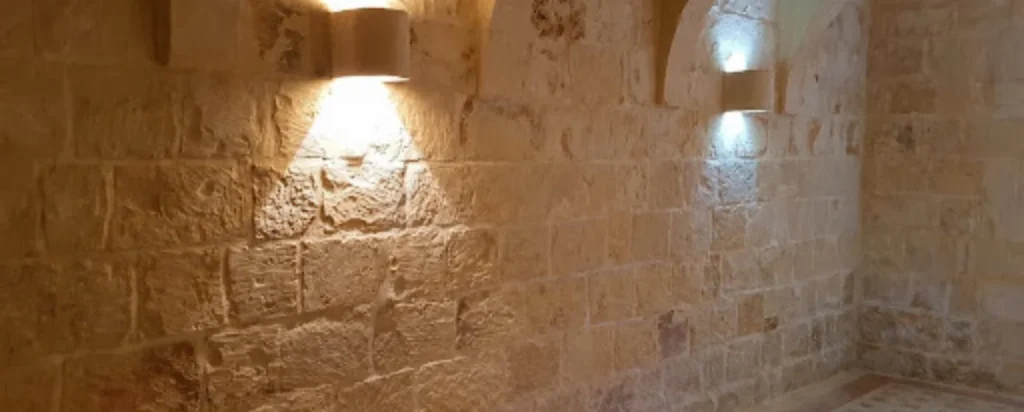

Why Plaster Peels Off in Maltese Houses

Understanding delamination from salts and “wrong” materials (and what to do about it)
If you’ve ever seen plaster bubbling, hollow-sounding, cracking, or literally peeling off a wall in a Maltese townhouse or farmhouse, you’re not alone. It’s one of the most common headaches we see locally, especially in older buildings built in Globigerina limestone (franka) and in properties close to the sea.
This article explains, in plain language, why plaster delaminates, why salts are often the hidden villain, how poor material compatibility makes everything worse, and what a proper long-lasting solution looks like.

A successful renovation starts long before the final paint coat — it starts with compatible materials and good preparation.
What does “delaminating plaster” actually mean?
“Delamination” simply means the plaster has lost its bond to the surface behind it.
Think of plaster like a sticker on a wall:
- When everything is right, it grips strongly and stays flat.
- When something pushes behind it (moisture, salts, movement), the sticker starts to lift, bubble, and peel.
A classic sign is when you tap the wall and it sounds hollow in places — like knocking on a door instead of a solid wall.
“Understand the wall before covering it.”
Why is this so common in Malta?
Malta is a perfect storm for plaster failure because we often have:
- Salt exposure (sea spray, salt-laden winds, contaminated stone, old groundwater salts)
- Rising damp (especially at ground floor level)
- High humidity cycles (walls absorbing and releasing moisture)
- Hard cement-based renders used on soft limestone
- Old buildings that were meant to breathe being “sealed up” with modern materials
A Maltese stone wall is not supposed to behave like a waterproof concrete tank. It behaves more like a sponge: it absorbs moisture, then releases it. When we apply the wrong materials, we block that natural breathing.
The two big causes
Salts: the silent wrecking ball inside your wall
Poor material compatibility: plaster that fights the wall instead of working with it
Let’s break both down.
Salts: why they push plaster off the wall
Salts get into masonry in a few ways:
- Moisture rising from the ground carries dissolved salts up the wall (rising damp).
- Sea spray and aerosols deposit salts on façades (especially coastal and wind-facing elevations)
- Old stone can already contain salts from its history (especially in certain exposures)
- Past cement repairs can “drive” moisture and salts into neighbouring areas

Efflorescence vs “hidden salts”
You might have seen white powdery deposits on walls. That’s efflorescence: salts reaching the surface and crystallising where you can see them.
But the more damaging problem is often subflorescence: salts crystallising under the surface, inside the plaster or at the plaster–stone interface.
The ice-in-a-crack analogy (but with salt)
When water freezes in a crack, it expands and can split stone. Salt crystals can behave in a similar “expanding pressure” way inside tiny pores.
So as moisture moves through the wall:
It dissolves salts like sugar dissolves in tea.
As the wall dries, the salts crystallise.
Those crystals grow in pores.
Growth creates pressure.
Pressure breaks the plaster’s bond → blistering, cracking, delamination.
Poor material compatibility: when plaster and stone are “enemies”
A big mistake (and a very common one) is using hard, dense cement render on soft, porous limestone.
Even worse: many salts are hygroscopic (they attract moisture from the air).
So the wall never truly dries — it keeps cycling damp → dry → damp, and the salt keeps doing damage.
Why that’s a problem
Globigerina limestone is relatively soft and open-pored. It performs best with systems that are:
- Vapour-open (moisture can escape as water vapour)
- Capillary-active (moisture can move through pores rather than being trapped)
- Mechanically compatible (not too hard, not too stiff)
Cement renders are often the opposite:
- Dense
- Less breathable
- High strength
- High stiffness
It’s like putting a rigid plastic shell over a wall that naturally needs to “breathe and move a little.”
The raincoat analogy
Imagine your wall is a person and moisture is sweat.
- A breathable lime system is like a Gore-Tex jacket: it keeps weather out but lets vapour escape.
- A dense cement render is like a plastic raincoat: sweat can’t escape, so you end up wet inside.
When moisture is trapped behind a dense render, it searches for the weakest exit — and that’s often:
- The bond line behind the plaster
- Edges around cracks
- Junctions near openings
So the plaster begins to detach.
“Harder is better” is not true here
Many people assume stronger plaster means better durability. On modern concrete structures, sometimes yes. On traditional limestone, not necessarily.
If the plaster is stronger than the stone, the wall can’t “give” safely — and damage may happen in the stone or the interface.
Typical warning signs you can spot early
You don’t need a lab to notice the early clues:
- Hollow sound when tapped
- Bubbling or “pillowing”
- Flaking paint repeatedly in the same area
- Powdery surface, dusty plaster
- Salt stains / white crystals
- Damp patches that come and go with weather
- Plaster breaking away near skirting level (classic rising damp zone)
- Musty smell in corners or behind furniture
The most common “quick fixes” that backfire
These are the things that usually hide the problem for a few months… then it returns worse:
- Skimming over salt-damaged plaster with gypsum filler
- Painting with impermeable “anti-damp” paints
- Applying waterproof cement slurry on the inside
- Re-rendering with a dense sand/cement mix “to make it strong”
- Sealing everything without fixing the moisture source
These approaches often trap moisture and salts, meaning the wall continues deteriorating behind the scenes.
So what’s the correct approach?
A durable solution usually follows a simple logic:
Identify the moisture source
Salts don’t move without moisture.
So first ask:
- Is this rising damp from ground?
- Is it rain penetration through a façade?
- Is it condensation from humid indoor air?
- Is it plumbing leakage?
- Is it a combination?

Different moisture sources need different solutions. Treating the plaster without controlling moisture is like repainting a car without solving the rust underneath first.
Remove failed/contaminated plaster properly
If plaster is delaminating, it’s usually already compromised. Patch repairs often fail because salts remain in the surrounding material.
A proper removal typically involves:
- Taking off loose plaster until you reach sound, well-bonded material (or ideally, your original masonry surface)
- Extending beyond the visible damage (salts spread wider than the stain you see)
- Cleaning the substrate carefully (without “polishing” it smooth) – washing the walls with deionised water first, helps to remove residual salts on the immediate surface.
Choose a compatible “breathable” system
In salt-prone masonry, you generally want a plaster system that can:
- Handle moisture movement
- Provide space (porosity) for salts to crystallise without destroying the finish
- Remain mechanically compatible with limestone
- A good example of a salt-resistant plaster is the Rofix SanoCalce Fondo, which is applied first as a basecoat (before your main plastering coat) at around 8mm thick.

This is where lime-based renovation plasters and sacrificial layers can be extremely effective when specified correctly.
Key idea: sometimes the plaster is designed to be the “buffer” that takes the punishment, so the stone survives. An ideal product that uses soft lime and remains highly vapour-open is the Rofix Intonatura, which is applied over the Rofix SanoCalce Fondo at around 10-12mm thick. This becomes your main plaster coat, allowing vapour movement outward from your wall.

Finish with vapour-open paints/finishes
Even the best plaster can be sabotaged by the wrong paint.
If you finish a breathable plaster with a low-breathability acrylic, you’ve basically put the plastic raincoat back on.
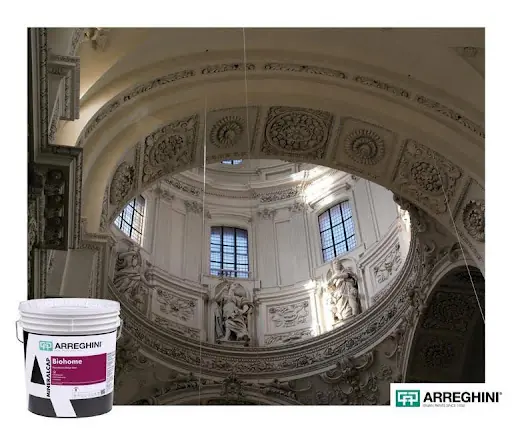
Vapour-open finishes (e.g. Arreghini Biohome) allow the system to do its job. In case you want to give your paint finish a higher resistance against mould, add half a bottle of Arreghini A1 fungicide to your Biohome paint.
A simple way to think about the “right” system
When dealing with traditional Maltese stone, think in three words:
Breathable. Compatible. Forgiving.
- Breathable: lets moisture escape as vapour
- Compatible: not harder/stiffer than the stone
- Forgiving: handles salts without blowing apart
Frequently asked questions
If I remove the plaster, will the wall dry?
Sometimes yes — but if moisture is still coming in (rising damp, rain, condensation), it will keep feeding the salts. Removal alone isn’t a full cure.
Can I just use waterproofing on the inside?
It can trap moisture and push the problem elsewhere. In many traditional buildings, that’s a recipe for worse decay.
Is this always rising damp?
No. Malta also sees rain-driven damp, coastal salt loading, plumbing leaks, and condensation. Diagnosis matters.
How do I know if it’s salts?
White crystals are a clue, but not the full story. The most reliable method is testing — however even without tests, the pattern (height, location, recurrence, history) often tells a lot.
When you should call a specialist (and not guess)
If any of these apply, get proper guidance:
- The problem keeps returning despite repairs
- The wall is historically significant (heritage value)
- The plaster is failing across large areas
- You have timber, iron, or finishes that could be damaged by trapped moisture
- You’re planning an expensive renovation – plan ahead and don’t apply any material on problematic, unstable walls
Closing thought: fix the “cause”, not the “symptom”
Delaminating plaster is a symptom: the wall is telling you something is wrong behind the surface.
If you treat it like a cosmetic problem, it will keep coming back. If you treat it like a moisture + salt + compatibility problem, you can get a solution that lasts.
Need help choosing the right plaster or paint system?
Econova Malta helps homeowners, architects and contractors assess damp, salts and material compatibility before renovation works begin.
We recommend breathable, mineral and lime-based systems designed to work with traditional Maltese limestone — not against it.
Before covering the problem, understand what your wall needs.

8 min read