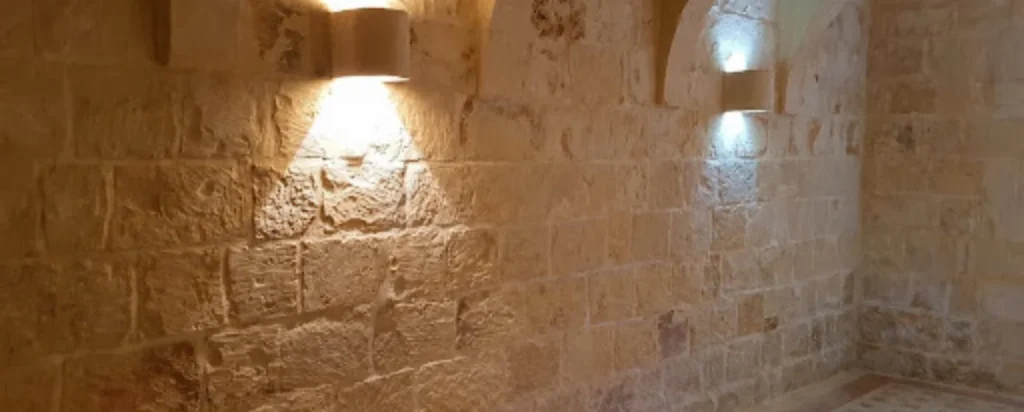

Salt Removal from Maltese Limestone Walls

How desalination poultices can give historic masonry and new lime plaster a cleaner start
Rising damp rarely travels alone. Its partner in crime is often hiding in dissolved form:
soluble salts.
As moisture rises through the small interconnected pores of a wall, it can carry chlorides, sulphates, nitrates and other salts with it. The water may later evaporate, but the salts remain behind.
Ground moisture is not the only possible source. Salts can also enter Maltese walls through marine aerosols, rain penetration, contaminated building materials, plumbing problems and the building’s previous use.
Over time, these salts can damage paint, plaster and even the limestone itself.
Why salts damage Maltese limestone
While salts remain dissolved in water, they are mostly invisible.
The damage begins when changing temperature and humidity conditions cause them to crystallise.
This can happen:
- On the wall surface as visible white deposits, known as efflorescence
- Beneath the surface, inside the pores of the stone or plaster, known as subflorescence.
Crystallisation beneath the surface is usually the more destructive of the two.

A higher content of salts seen here, taking the path of least resistance: through the softer porous joints (‘fili’).
“Desalination poultices reduce damaging salts in historic Maltese limestone”
As salt crystals grow inside confined pores, they exert pressure against the surrounding material. Repeated wetting and drying can gradually create fine cracks, powdering, scaling and loss of the stone surface.
University of Malta research describes how crystal growth in pores creates pressure and how repeated wetting-and-drying cycles can lead to disintegration of the stone.
This damage usually develops slowly—day after day and year after year.
Now imagine a wall that is 200, 300 or even 400 years old. It may have experienced thousands of moisture and drying cycles, giving salts plenty of time to migrate and accumulate within the masonry.

Salt damage can shorten the limestone’s lifetime through accelerated erosion.
What University of Malta research tells us
Understanding the fabric of our unique limestone is critically important in being able to make the right analysis. As such we are lucky to have access to some excellent research on Globigerina limestone by the University of Malta. The research found a “significant correlation between visible damage and salt load” in Globigerina limestone. The study associated severe weathering with high concentrations of halite and identified salt weathering as a principal deterioration mechanism in Maltese Globigerina limestone.
At the Church of Santa Marija Ta’ Cwerra in Siġġiewi, severely weathered zones were associated with high concentrations of halite, or common salt. The research identified salt weathering as a principal deterioration process affecting Maltese Globigerina limestone.
Other University of Malta research notes that the local environment is heavily influenced by sea salts, particularly sodium chloride and sulphates. It also shows that different qualities of Globigerina limestone respond differently depending on their pore structure and mineral composition.
This does not mean every old Maltese wall contains the same salts or the same concentration. Salt contamination is site-specific. Where the damage is severe or valuable historic fabric is involved, testing is preferable to guesswork.
Why salt-resistant plaster may not be enough
Renovation plasters are designed to cope with contaminated masonry far better than ordinary gypsum plaster or a standard lime plaster.
Their open, porous structure can provide space in which salts crystallise with less immediate damage.
But no plaster has unlimited capacity.
If the wall contains a very high salt load—or if moisture continues feeding more salts into it—even a good salt-resistant plaster can eventually become overwhelmed.
Think of the plaster as a filter.
A high-quality filter can hold more contamination than an ordinary one, but it still performs better when the heaviest contamination has been reduced first.
Salt deposits are often concentrated around the wall’s evaporation zone, close to the surface, although their exact depth and distribution vary from one wall to another. Removing or reducing this near-surface salt burden can give the new plaster a much better starting point.

What is a desalination poultice?
A desalination poultice, sometimes called a desalination compress or salt-removal poultice, is a temporary absorbent layer applied to the wall in a similar way to plaster.
The wall is prepared according to the chosen system, and the poultice is applied over the salt-contaminated masonry. Moisture and dissolved salts gradually migrate from the near-surface pores of the stone into the absorbent material.
The poultice effectively moves the evaporation zone away from the stone and into a temporary layer that will later be discarded.
This treatment is not magic, although the result can sometimes look remarkable. It is a controlled use of moisture movement, diffusion, capillary transport and evaporation.
University of Malta conservation research has also investigated sacrificial lime plasters as a way of reducing salt damage to Globigerina limestone [3], including at the eighteenth-century Nymphaeum in Argotti Gardens, where salt damage had caused severe powdering and spalling.
What happens during treatment?
The poultice is applied as a substantial temporary coat and left undisturbed while salts migrate into it.
As it dries, the layer may:
- Become firmer or harder
- Develop harmless drying cracks
- Show areas of salt accumulation
- Detach slightly from the background
- Become easier to peel or remove
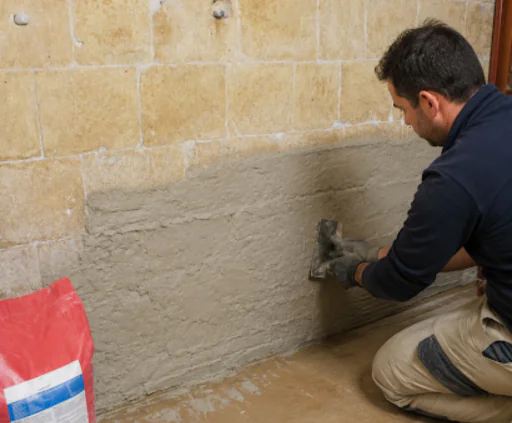
Applying a desalting poultice is very similar to applying a thick paste or plaster to the wall.
The required standing time is not universal. It depends on the product used, application thickness, wall moisture, temperature, humidity and substrate absorption.
The poultice should therefore be removed according to the selected manufacturer’s technical instructions and the actual drying condition—not simply because a fixed number of days has passed.
Once removed, the spent material carries part of the wall’s near-surface salt burden with it.
Where contamination remains high, a second or further application may be justified. Ideally, this decision should be supported by an assessment or salt testing rather than automatically specifying the same number of treatments for every wall.
Does a poultice remove every salt?
No.
A desalination poultice mainly reduces salts close to the surface and within the evaporation zone. It cannot guarantee complete removal from the full thickness of a historic wall.
Nor does it stop rising damp, repair rain penetration or fix a leaking pipe.
If moisture continues entering the wall, salts from deeper within the masonry may eventually migrate back towards the surface.
The treatment should therefore form part of a wider approach:
Identify and reduce the moisture source where reasonably possible.
Remove loose and incompatible finishes carefully.
Reduce excessive near-surface salts where necessary.
Reassess the exposed masonry.
Apply a compatible breathable wall system.
A poultice does not make the wall new. It gives the repair a cleaner and fairer starting point.
Choosing the plaster system afterwards
The correct plaster system depends on the remaining salt load, moisture source, stone condition and whether the application is internal or external.
Where masonry remains affected by moisture and soluble salts, the RÖFIX SanoCalce system is usually the most appropriate of the three Econova options.
SanoCalce Intonaco is a macroporous renovation plaster intended for masonry affected by moisture and contamination from nitrates, chlorides and sulphates. SanoCalce Fondo is designed for use where higher salt concentrations are present.

RÖFIX CalceClima
Where the salt burden has been sufficiently reduced and a compatible lime plaster build-up is appropriate, the RÖFIX CalceClima system may be considered.
CalceClima Ambiente is an NHL-based plaster with high vapour permeability, low-stress hardening and moisture-regulating properties. It should not, however, be treated as a substitute for a dedicated renovation plaster on heavily salt-loaded masonry.
RÖFIX Renopor
For selected internal applications, RÖFIX Renopor boards provide a capillary-active, moisture-regulating internal board system.
Its high capillarity helps manage internal surface moisture and reduce condensation risk. It is not itself a desalination treatment, and its suitability should be determined after the wall has been properly assessed. That said however they’re an excellent choice when the internal humidity is generally high. They’re particularly effective on external walls and condensation problems.
The correct choice should follow diagnosis—not product preference alone.
When should salt-removal treatment be considered?
A desalination poultice may be worth investigating when:
- Salts repeatedly return after cleaning
- Previous breathable plasters have still failed
- Thick white deposits form on the surface
- The exposed stone is powdering, scaling or spalling
- The wall has a long history of rising damp or water entry
- Valuable historic stone needs a gentle treatment
- Testing identifies a high near-surface salt concentration
Historic walls are rarely uniform. A trial area is often the safest way to confirm how the masonry and the selected poultice will behave.
Frequently asked questions
Can a salt poultice remove every salt from a historic wall?
No. It mainly reduces salts close to the masonry surface. Deeper salts may remain, and new salts may migrate forward if moisture continues entering the wall.
How many applications are required?
It depends on the salt type, concentration and distribution. One application may produce a useful reduction, while heavily contaminated masonry may require further treatments.
Can the wall be plastered immediately afterwards?
Not automatically. The poultice must be removed, the surface cleaned and reassessed, and the wall allowed to reach suitable conditions before the selected plaster system is applied.
Giving an old wall a cleaner start
Removing near-surface salts can feel a little like turning back the hands of time.
It cannot erase everything that happened inside a centuries-old wall. But it can remove part of the contamination accumulated through years of moisture movement and reduce the burden placed on the new plaster.
The guiding principle is simple:
Reduce the source of moisture. Reduce the near-surface salt load. Then rebuild with compatible, breathable materials.
That gives both the Maltese limestone and the new finish a much better chance of lasting.
Need help with salt-contaminated Maltese limestone?
Econova Malta helps homeowners, architects and contractors assess salt-damaged masonry and select appropriate desalination, lime-plaster and moisture-regulating systems.
Before replastering a wall that has failed repeatedly, speak to us about whether salt-reduction treatment should form part of the renovation specification.

8 min read